At a glance
Key takeaways
- TellTide is easier to reason about when feedback already arrives in structured categories.
- Sleekplan is built for teams combining feedback from more channels and using AI to find themes and duplicates.
- Choose based on feedback volume and workflow complexity, not the longest feature list.
Publisher disclosure: TellTide publishes this comparison. Vendor descriptions are based on public documentation, not a hands-on benchmark. TellTide requires a Pro subscription; it does not include a built-in changelog, automated email notifications or ready-made integrations.
AI feedback operations or deliberate human triage?
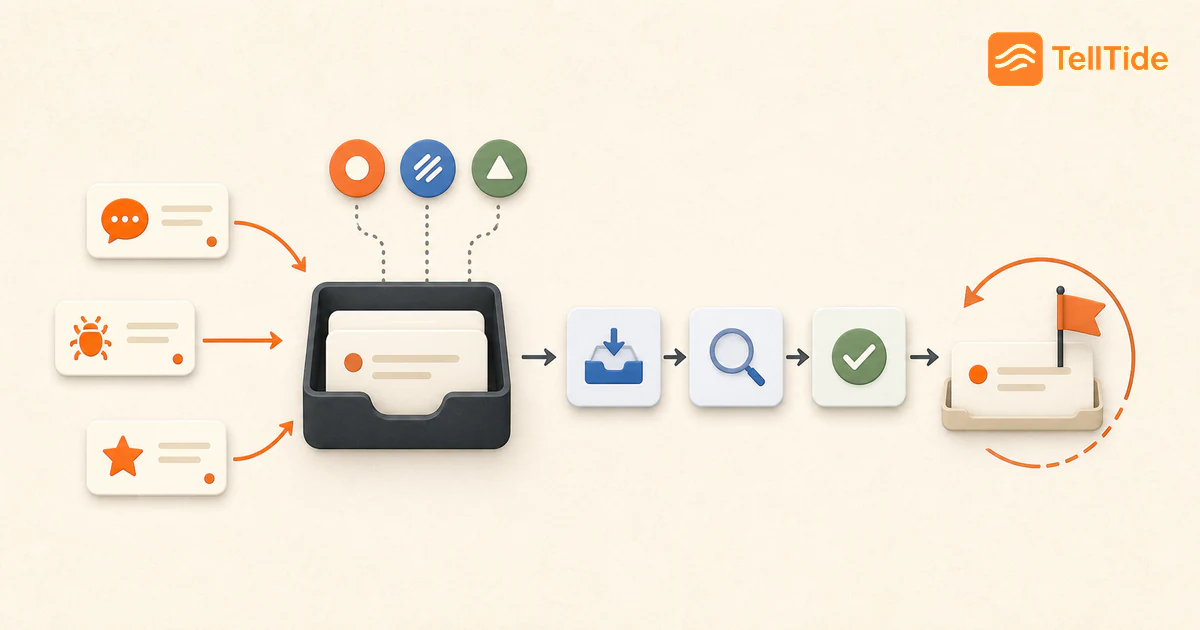
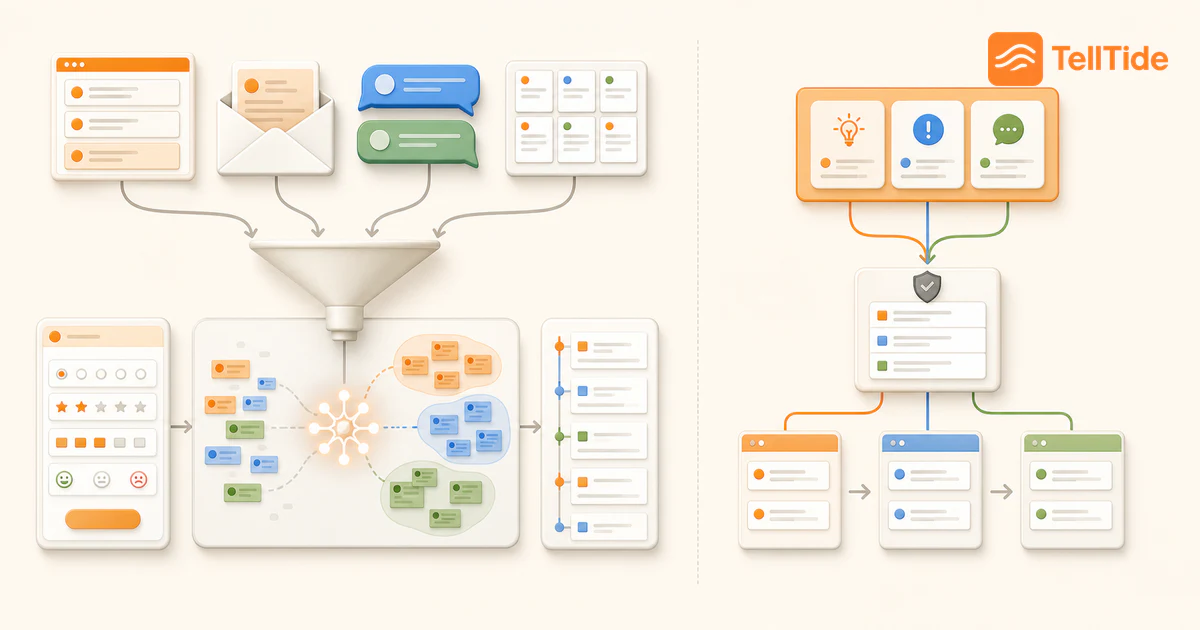
TellTide suits teams that want users to identify what they are sharing at the start: a review, bug, feature request, or general feedback. That structure keeps the inbox understandable, while the API and public roadmap cover custom capture and loop-closing.
Sleekplan suits teams receiving feedback from more places. Its current product direction emphasizes AI extraction and organization across conversations, reviews, portal posts, and other channels, alongside surveys, a feedback board, roadmap, and changelog. Its PM Agent and MCP server extend that analysis and product-operations workflow into AI-assisted tools.
Sleek Intelligence compared with TellTide’s structured inbox
| Capability | TellTide | Sleekplan |
|---|---|---|
| Primary workflow | Structured widget or API → inbox → public roadmap | Multi-channel feedback → AI organization → roadmap → changelog |
| Feedback analysis | Human triage using types, filters, search, and status | AI theme extraction, duplicate merging, categorization, and impact scoring |
| Research tools | Focused feedback forms and review ratings | Multi-step surveys, conditional questions, NPS, and segmentation |
| Communication | Roadmap votes, comments, and statuses | Feedback board, roadmap, changelog, and in-app announcements |
| Agent workflow | HTTP API and documented agent tools for feedback submission | PM Agent and MCP server for analysis and product operations |
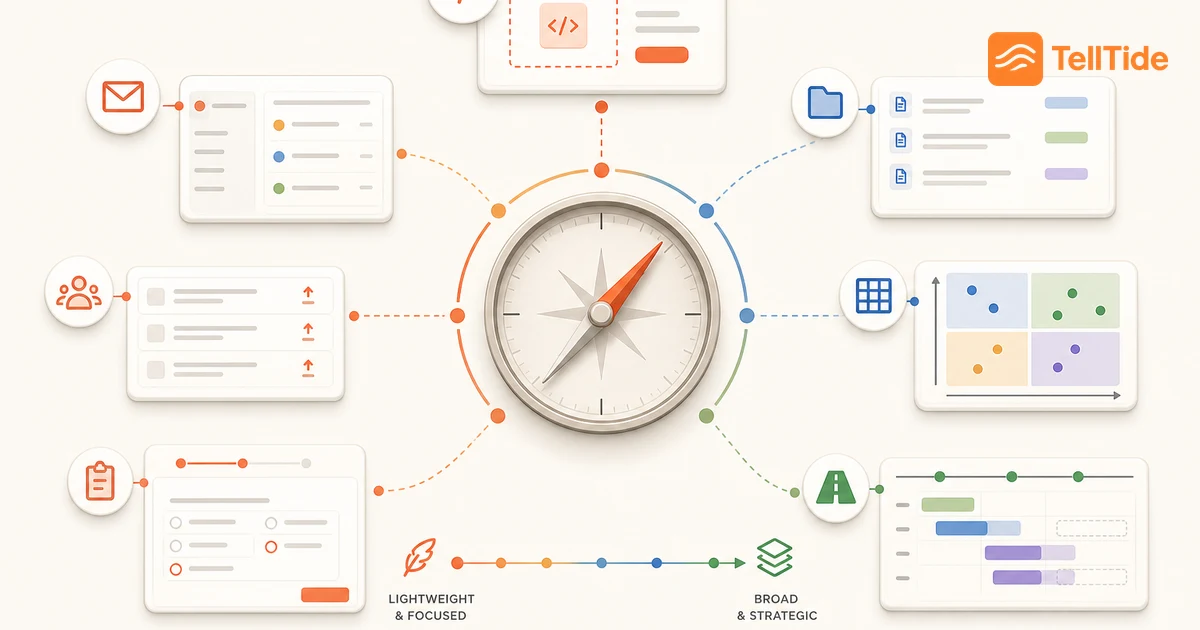
| Best fit | Small teams with a straightforward feedback volume | Teams consolidating larger, noisier feedback streams |
Choose TellTide when simple structure beats automated analysis
A team does not need AI clustering when it receives a manageable number of well-labeled messages. TellTide lets the user provide the first layer of classification and gives the product owner a clean place to review the result.
This keeps the weekly workflow light: check new items, update their status, and publish roadmap candidates. It is especially practical when support and research already live in other tools and do not need to be consolidated.
Choose Sleekplan when feedback volume creates real analysis work
Sleekplan becomes more compelling when feedback is spread across support tickets, app reviews, surveys, and a public portal. Automated theme detection, duplicate handling, and scoring can reduce the manual work of turning that noise into a coherent set of product signals. Its PM Agent and MCP interface matter when a team also wants AI-assisted analysis and roadmap operations beyond basic feedback capture.
Its surveys and changelog also expand the workflow from listening to active research and release communication. If your team will use that breadth, it can replace several smaller tools. If not, TellTide keeps the feedback loop easier to operate.
Evaluate the surfaces as one customer journey
Create a realistic journey in Sleekplan: a customer opens the widget, submits or votes on feedback, responds to a survey, sees a roadmap change, and reads a release update. Check visual consistency, identity handling, notification behavior, moderation, and the work required to keep each module current.
Repeat the narrower journey in TellTide: collect structured feedback, triage it privately, and publish a qualified request to the roadmap. Include a bug report and review so the team can see whether separating feedback types improves routing.
Track which workflow produces clearer submissions and fewer administrative steps for the jobs you actually perform. A broader suite is valuable when surveys and changelogs are part of the operating plan; otherwise unused customer-facing modules can become stale surfaces that weaken trust.
Measure analysis corrections, not just automation volume
Sleekplan describes extracting signals from conversations, merging duplicates and operating through a PM Agent and MCP server. Those capabilities address a different bottleneck from installing a feedback form. Evaluate them when the team actually spends time synthesizing dispersed input.
Use a sample whose meaning your team already understands. Check whether similar wording hides different problems, whether separate accounts remain distinguishable and whether a proposed theme can be traced to its source. Record corrections and review time, not merely the number of records processed.
This is a proposed evaluation method; no accuracy or time-saving benchmark is claimed here. TellTide does not provide equivalent AI clustering. For a manageable queue, the small-team review routine may be sufficient.
Put this into practice: Get Pro
Questions teams ask before choosing this workflow
Is TellTide a Sleekplan alternative?
Yes, for teams needing structured feedback capture, inbox triage, and a public roadmap. Sleekplan is broader, with AI analysis, surveys, changelogs, and multi-channel feedback consolidation.
Which tool is better for surveys?
Sleekplan offers a more complete survey workflow with multi-step forms, conditional questions, targeting, and multiple question types.
Which tool is simpler for a small SaaS?
TellTide has the narrower workflow. Sleekplan may be a better fit when feedback volume and channel count create enough complexity to benefit from automation.
Research notes
Sources reviewed
These references support the discussion above. Specific pricing checks are dated in the article; its editorial update date does not imply that every linked page was reverified. Confirm plan availability with each vendor.

Abhijith
Founder of TellTide, writing practical guides about product feedback, feature requests, and public roadmap workflows for SaaS teams.