
At a glance
Key takeaways
- TellTide is stronger when private reviews, bugs, general feedback, and feature requests should share one structured inbox.
- Frill is stronger when ideas, roadmap communication, announcements, and surveys form one public-facing workflow.
- Both are approachable; the right choice depends on where you want customer feedback to begin.
Publisher disclosure: TellTide publishes this comparison. Vendor descriptions are based on public documentation, not a hands-on benchmark. TellTide requires a Pro subscription; it does not include a built-in changelog, automated email notifications or ready-made integrations.
Public ideas and announcements or private structured intake?
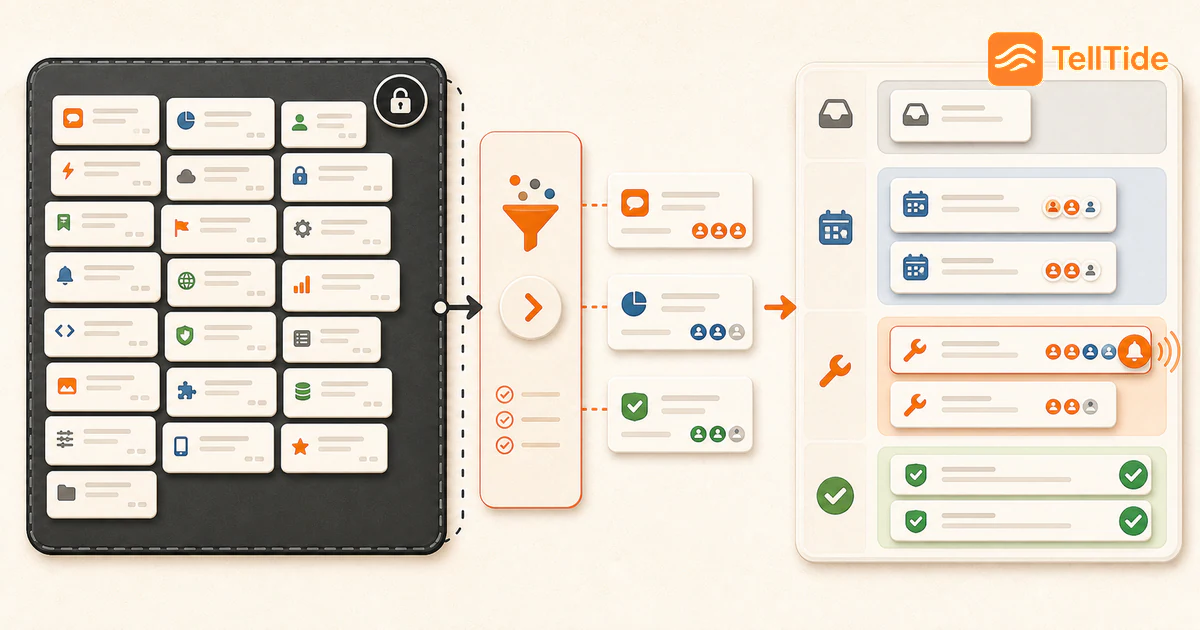
Choose TellTide when customers should be able to report different kinds of product feedback without sending every message to a public board. Reviews, bugs, general comments, and feature requests enter a private inbox, and the team can promote suitable requests to the roadmap.
Choose Frill when you want an ideas hub to connect directly with a public roadmap and announcements. Frill also offers targeted surveys, inline administration on the customer-facing site, a configurable prioritization matrix, integrations, and customization, making it a broader customer communication layer around product ideas.
Frill’s customer communication stack compared with TellTide
| Capability | TellTide | Frill |
|---|---|---|
| Primary workflow | Widget or API → private feedback inbox → public roadmap | Ideas → prioritization → roadmap → announcements |
| Feedback structure | Separate reviews, bugs, feature requests, and general feedback | Ideas plus surveys and customer discussion around requests |
| Public experience | A curated roadmap with voting, comments, and statuses | Ideas, roadmap, and announcements presented as a connected hub |
| Additional workflow | API submissions for custom product surfaces | Targeted surveys, inline admin, announcement widgets, integrations, and a prioritization matrix |
| Best fit | Teams prioritizing private structured intake | Teams prioritizing public ideas and release communication |
Choose TellTide when not every message should be an idea
A customer review, a broken screen, and a feature suggestion require different responses. TellTide separates those categories at the point of capture, which makes the inbox easier to review and keeps sensitive or incomplete reports out of public view.
The team still gets the benefits of a customer-facing roadmap. The difference is that publication is a deliberate step after triage. This fits founders who want openness around real product candidates without turning the whole feedback stream into a forum.
Choose Frill when ideas and announcements belong together
Frill is a natural choice when the public ideas board is the beginning of the workflow and product announcements are the end. Customers can contribute ideas, see priorities take shape, and hear about releases in a connected experience. Inline admin lets the team manage that workflow from the customer-facing surface instead of always returning to a separate back office.
Its surveys and integration options also matter when you want more active research or a wider customer communication setup. If those are regular parts of your process, Frill offers useful breadth. If the job begins with structured feedback triage, TellTide stays more focused.
Test the customer communication loop
Start with a request that has already moved from discovery to release. In Frill, recreate how the idea is collected, discussed, scored in the prioritization matrix, represented on the roadmap, announced, and measured through any active survey your team expects to use. The value comes from maintaining that connected communication cycle, not from enabling each surface once.
In TellTide, test whether private intake plus a curated public roadmap is enough. Submit a bug, a review, and a feature request; keep the first two private; publish the request; then update its status. This exposes whether your team needs a broader announcement and research layer or simply a clean feedback path.
Before migrating, inventory public links, voter identities, comments, attachments, statuses, and notification expectations. A customer-facing tool change is successful only when users can still understand what happened to the ideas they followed.
Check idea limits and privacy packaging together
Frill's pricing lists limits on ideas and surveys for entry plans, with privacy and branding options that require checking the chosen package. Count the ideas you intend to keep active before comparing the entry price with another subscription.
Frill also supports privacy controls. The comparison is not “public tool versus private tool”; it is whether your team benefits from an ideas-and-announcements workspace or from distinct product-feedback categories and inbox triage. TellTide does not provide a built-in announcements module.
During a trial, ask the release owner to draft a real update and identify its audience. If no one will maintain announcements, buying the module will not close the loop by itself. See how to communicate feedback decisions.
Put this into practice: Get Pro
Questions teams ask before choosing this workflow
Is TellTide a Frill alternative?
Yes. Both support feedback and public roadmap workflows, but TellTide uses private structured intake while Frill centers a public ideas, roadmap, and announcements experience.
Does TellTide include announcements?
TellTide communicates roadmap progress through statuses and comments. Teams specifically needing a changelog or announcements workflow should consider that difference.
Which tool is better for bug reports?
TellTide provides a dedicated bug feedback type inside its widget and inbox, making it the more direct fit when bug reports share the workflow with reviews and requests.
Research notes
Sources reviewed
These references support the discussion above. Specific pricing checks are dated in the article; its editorial update date does not imply that every linked page was reverified. Confirm plan availability with each vendor.

Abhijith
Founder of TellTide, writing practical guides about product feedback, feature requests, and public roadmap workflows for SaaS teams.